
Crayons, Markers, or Colored Pencils? A Practical Answer by Age
Every set on the shelf promises to be the one your child will finally love. What actually decides it is how much control their hands have, how much mess you can absorb, and what paper they are coloring on.
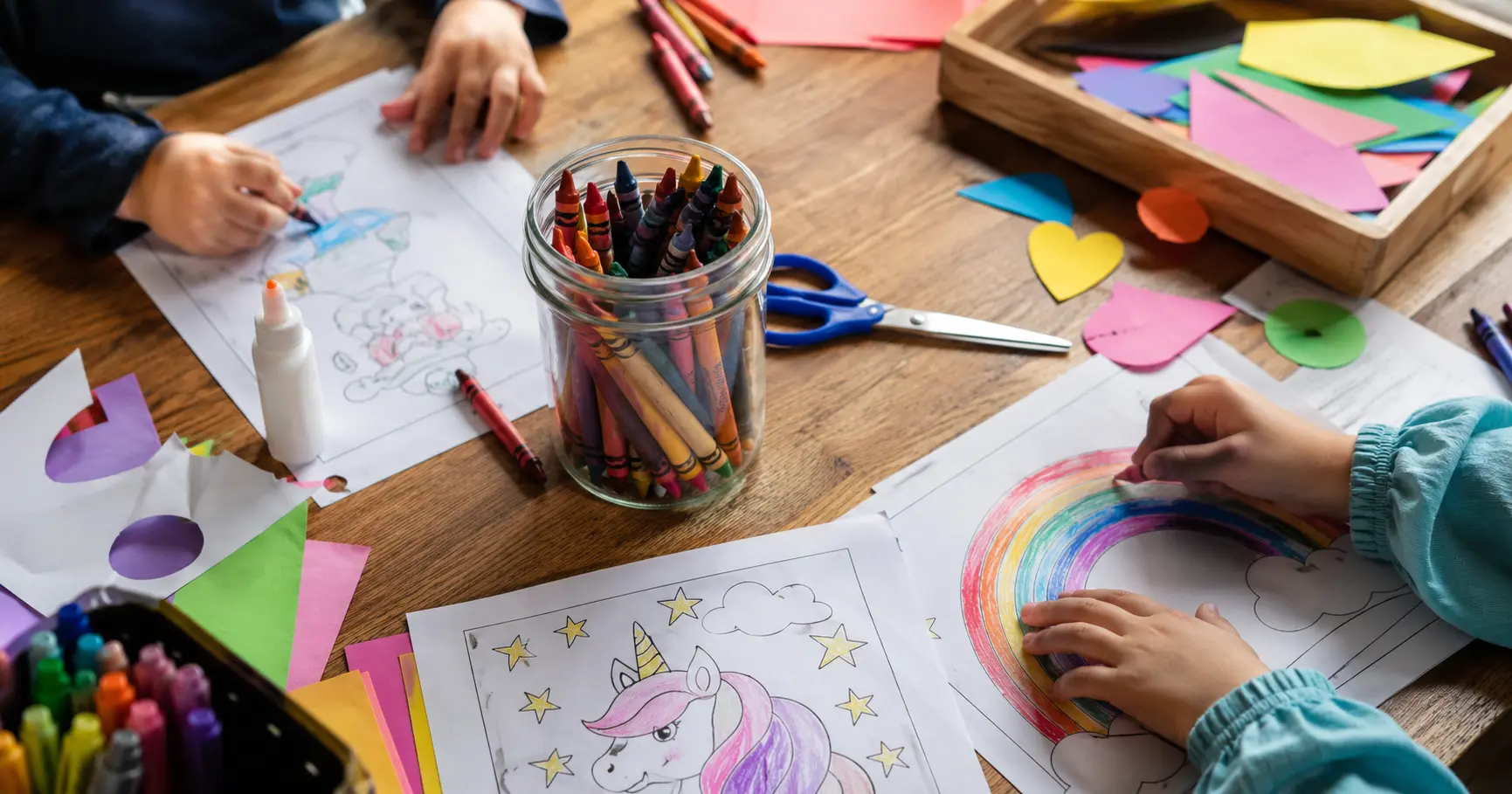
There is no winner here, which is annoying if you are standing in an aisle trying to buy one thing. What there is: three tools with quite different demands on a child’s hand, and an age at which each one stops being frustrating. Buy against that and coloring goes better. Buy the beautiful tin of seventy-two pencils for a three-year-old and it will sit in a cupboard.
Crayons — from about 18 months
Crayons forgive everything. They need no grip strength, they cannot spill, they do not dry out, and a chunky one survives being dropped, stood on, and briefly eaten. For toddlers and young preschoolers they are the only sensible first choice: the wax needs pressure to leave a mark, which is itself useful practice for the hand.
What they are bad at is precision. Small details, thin lines, tight spaces — a crayon will not do those, and expecting it to leads to a frustrated child. That is fine, because tight spaces are not what a three-year-old is after anyway. Bold, simple outlines are, which is the whole idea behind pages made for toddlers.
Markers — from about 3, with conditions
Markers are the ones children reach for, and it is easy to see why: brilliant color for almost no effort, instant results, no pressing hard. For a child whose hands tire quickly they can be the difference between finishing a page and giving up halfway.
The costs are real though. Caps get lost and the pens dry out. They bleed through thin paper and onto the table. Washable formulas wash off skin and most fabric but not everything, and “washable” has never once meant washable off a painted wall. If you can supervise, or you are happy to cover the table, they earn their place from about three. If not, wait a year.
Colored pencils — from about 4 or 5
Pencils ask the most and give back the most. They need real grip strength and pressure control, and a child who has neither gets pale, scratchy results and concludes they are bad at coloring. Give the same pencils to a five-year-old and suddenly there is shading, blending, deliberate light and dark.
They are also the tidiest option by a distance — no bleed, no stains, nothing to dry out — and the only one that handles fine detail, so they are the natural partner to the more intricate pages older children want. The catch is sharpening, which will become your job more often than you expect.
If you are buying one thing
- Under 3: chunky crayons. Nothing else is worth the trouble yet.
- Ages 3 to 4: crayons still in rotation, plus a small set of washable markers for supervised sessions.
- Ages 5 to 7: colored pencils as the everyday default, markers kept for when they want something bold.
- 8 and up: let them choose. By this point preference matters more than capability, and their preference is usually right.
Fewer colors than you think
A twelve-color set gets used. A ninety-six-color set gets tipped out, admired, and abandoned, and half of it is unrecognizable by the following week. Small sets also make choosing a color a real decision rather than a paralyzing one, which is quietly a good part of what coloring is for.
Match the tool to the hand, keep the sets small, and stop trying to hurry a child toward pencils because the results look tidier to adults. A scribbled crayon page finished with real enthusiasm is worth considerably more than a careful pencil page nobody wanted to make.